


Recent survey of building stones used in Cambridge
text and photos by Nigel Woodcock and Euan Furness
See blog here.
The geology of an area is often reflected in the materials used to construct its’ buildings. Recent studies in Cambridgeshire1, and in particular Cambridge2, demonstrate a remarkable millennium-long archive of building stone use which can be used to inform on the region’s geological past.
In pre-COVID times, the historic buildings in Cambridge were enjoyed by over eight million visitors each year, who learned something about their architecture but little about their geology. Recently, however, a comprehensive survey by Nigel Woodcock and Euan Furness from Cambridge University’s Department of Earth Sciences shows how stone use through time has been influenced by wars, by pandemics and by the canal and railway revolutions. The survey’s novel methodology will be useful for assessing heritage cities worldwide. Here, Nigel Woodcock explains more about the project:
The timing of our survey was very fortunate. Euan Furness did a pilot survey of some central colleges in summer 2017, then I did the full survey in summer 2019, little realising that the necessary access to colleges would soon be impossible due to COVID restrictions.
We recorded the external stone, in walls or as dressings, in every building in Cambridge except for private housing. For each historical building project, we identified the source quarry for the stone as far as possible, established the date of use from documentary evidence and assessed the volume of stone used. We amassed over 900 records of stone, even without recording roofing, paving or ornamental stone.
Our results show that over two-thirds of stone is from one of the nine quarry areas in the Lincolnshire Limestone Formation, which extends northwards from Corby through Stamford nearly to Lincoln. Most of the thirty or so other Cambridge stone types are also limestone, with only 6% being sandstone, flint and igneous rocks. It was particularly interesting to discover many new examples of stone from long-abandoned quarries, for instance Barnack, which was worked out by about 1460, and King’s Cliffe, last used in Cambridge in 1625.
The patterns of stone use through time show clearly how, until the nineteenth century, most stone was sourced from less than 100 kilometres from Cambridge, transported along the Fenland waterways. Exceptions are Dorset’s Portland limestone and Yorkshire’s Magnesian Limestone, both substantially transported by low-cost coastal boats. The use of most distant stone was only economic when canal links to southwest England were established in 1815 and when Cambridge was linked to the railway network from 1845. Both the volume and the variety of stone increased markedly during the nineteenth century and usage only declined after World War II.
As well as providing the basis for future popular guides to Cambridge stone, our work is a valuable database for architectural and transport historians. The novel methodology of our study should also be useful for assessing stone in other heritage cities worldwide.
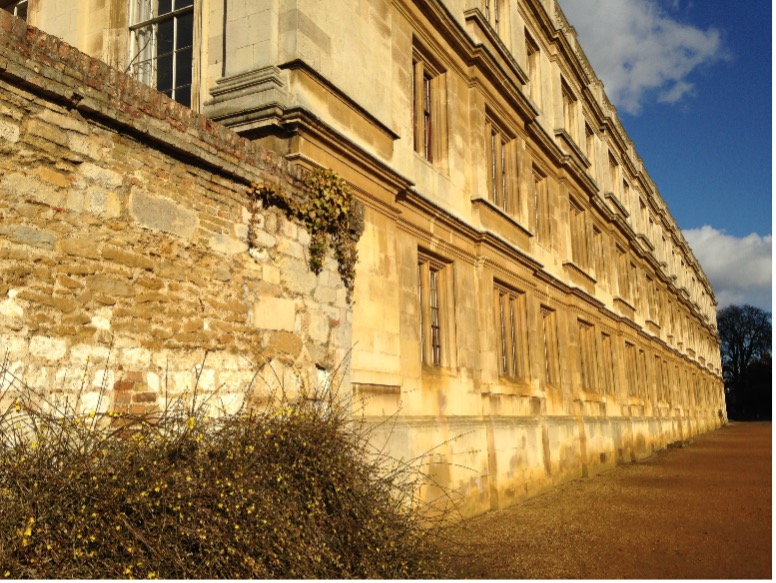
Middle Jurassic Ketton limestone from Lincolnshire has been used in the south range of Clare College Old Court. These Bajocian oolitic limestones have been used as a building stone since the C16th for many of the ancient buildings in the city and are named after the village of Ketton in Rutland.
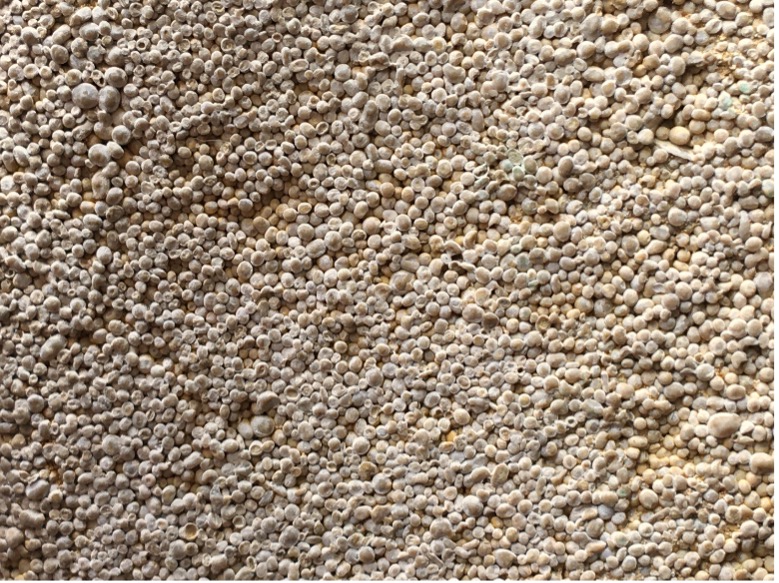
Middle Jurassic: Cambridge’s most common building stone in close up: Middle Jurassic Ketton limestone from Rutland. Ooid grains are about 1mm in diameter.
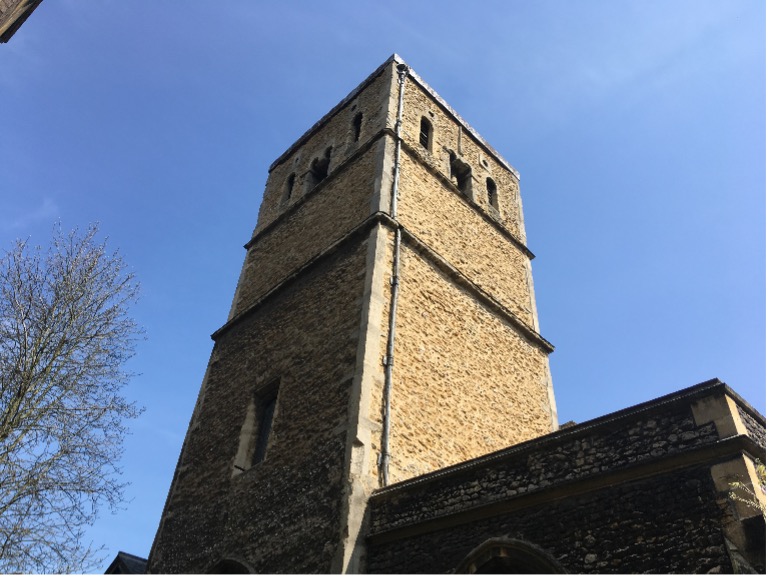
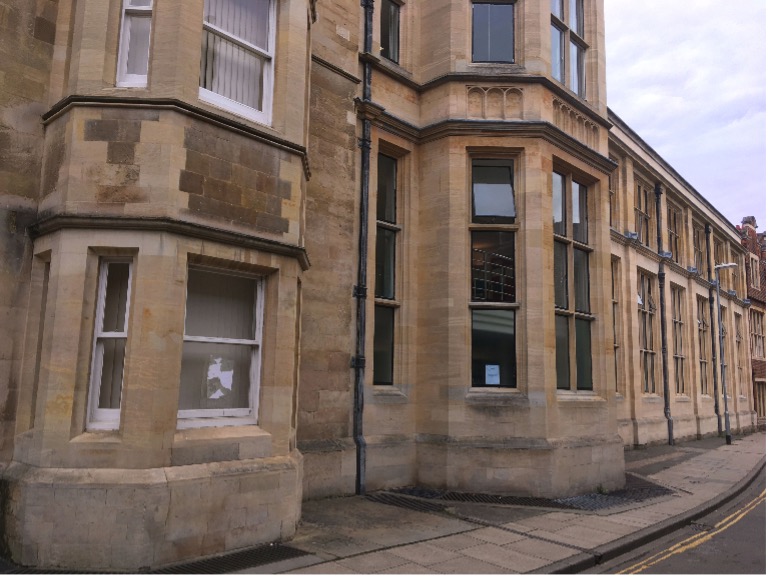
Middle Jurassic Ancaster limestone in the Old Cavendish building. These stones also form part of the Lincolnshire Limestone Group.
- Historic England (2019). Strategic Stone Study: A Building Stone Atlas of Cambridgeshire (including Peterborough) https://www2.bgs.ac.uk/mineralsuk/download/EHCountyAtlases/CambridgeshireBuildingStoneAtlas.pdf
- Woodcock, N.H. and Furness, E.N. (2021). Quantifying the history of building stone use in a heritage city; Cambridge, UK, 1040-2020. Geoheritage, 13, https://rdcu.be/ceA68 and https://doi.org/10.1007/s12371-021-00536-0.
Meldreth village webiste: Brick, Stone and Cement, Clunch and Clay Bat