


The Pleistocene ‘Ice Age’
We are currently in the Quaternary Period, which started 2.58 million years ago. From the start until 11,700 years ago, the Pleistocene (Epoch) ‘Ice Age’ brought very cold conditions to Europe including glacial periods when ice sheets covered much of the land (glaciations). These cold periods were interrupted by interglacials, when warmer, temperate conditions returned. The topography of Cambridgeshire has been greatly modified by geomorphological processes during the Pleistocene, including glacial and periglacial erosion, and the deposition of associated material such as the many deposits brought by glaciers and major river systems.
For more information on the Quaternary Period see What is the Quaternary – Quaternary Research Association.
Three sites in Cambridgeshire/Peterborough appear in the Top 50 Quaternary Sites – Quaternary Research Association

Pleistocene fossils
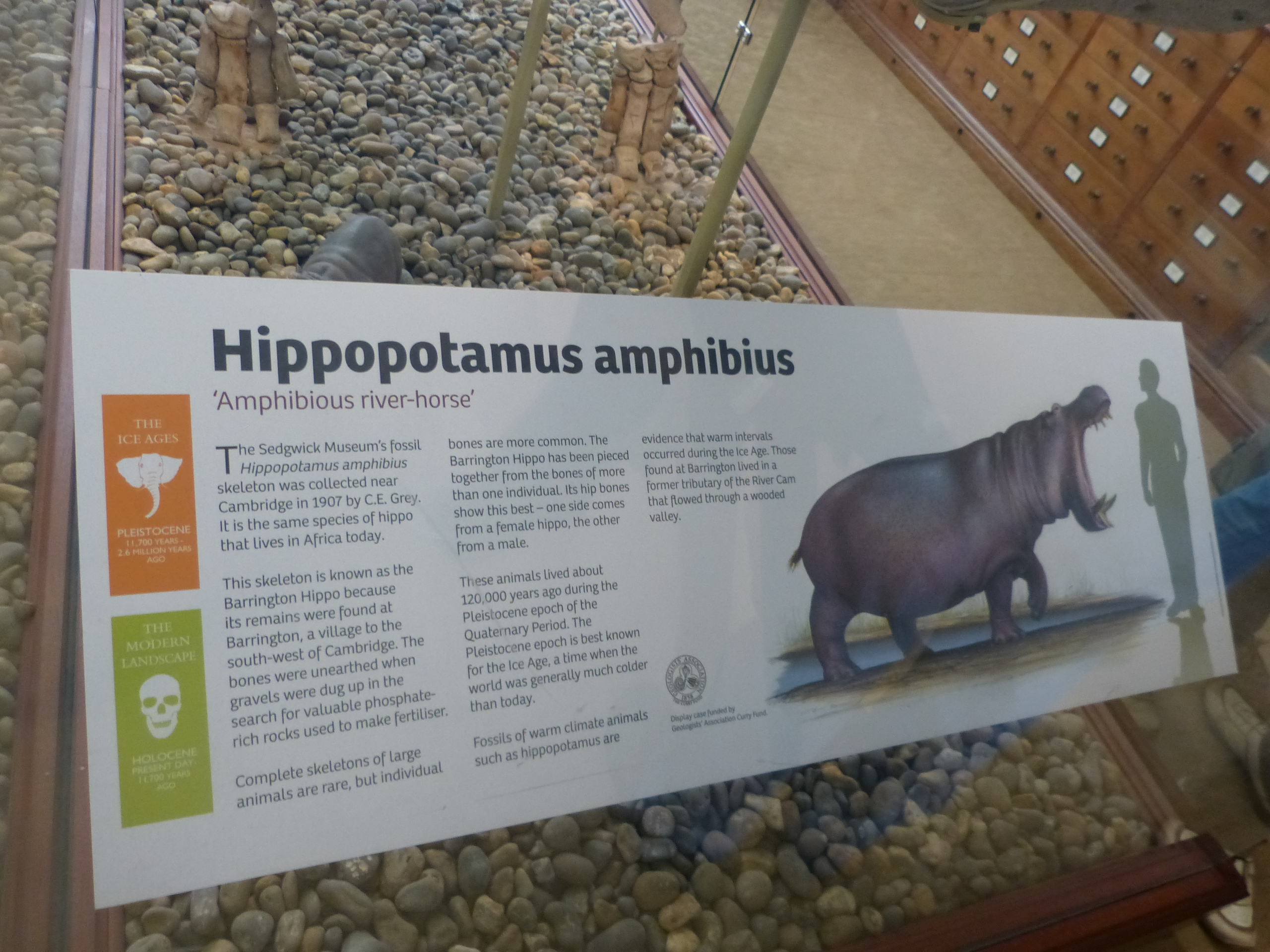
Due to the extensive deposits of River Terrace and other gravels in Cambridgeshire, there have been some amazing discoveries of fossils from both cold and warm periods of the Pleistocene ‘Ice Age’. Many (such as mammoth tusks) date from the last glaciation (the ‘Devensian’) when the region experienced tundra conditions but others (such as hippo skulls) date from the earlier warm phase (the ‘Ipswichian’). Others date from even earlier glaciations or warm periods.
Our local museums have excellent displays on the Pleistocene Ice Age, its geology, environments and fauna, with some impressive fossils – many of which have been found locally.
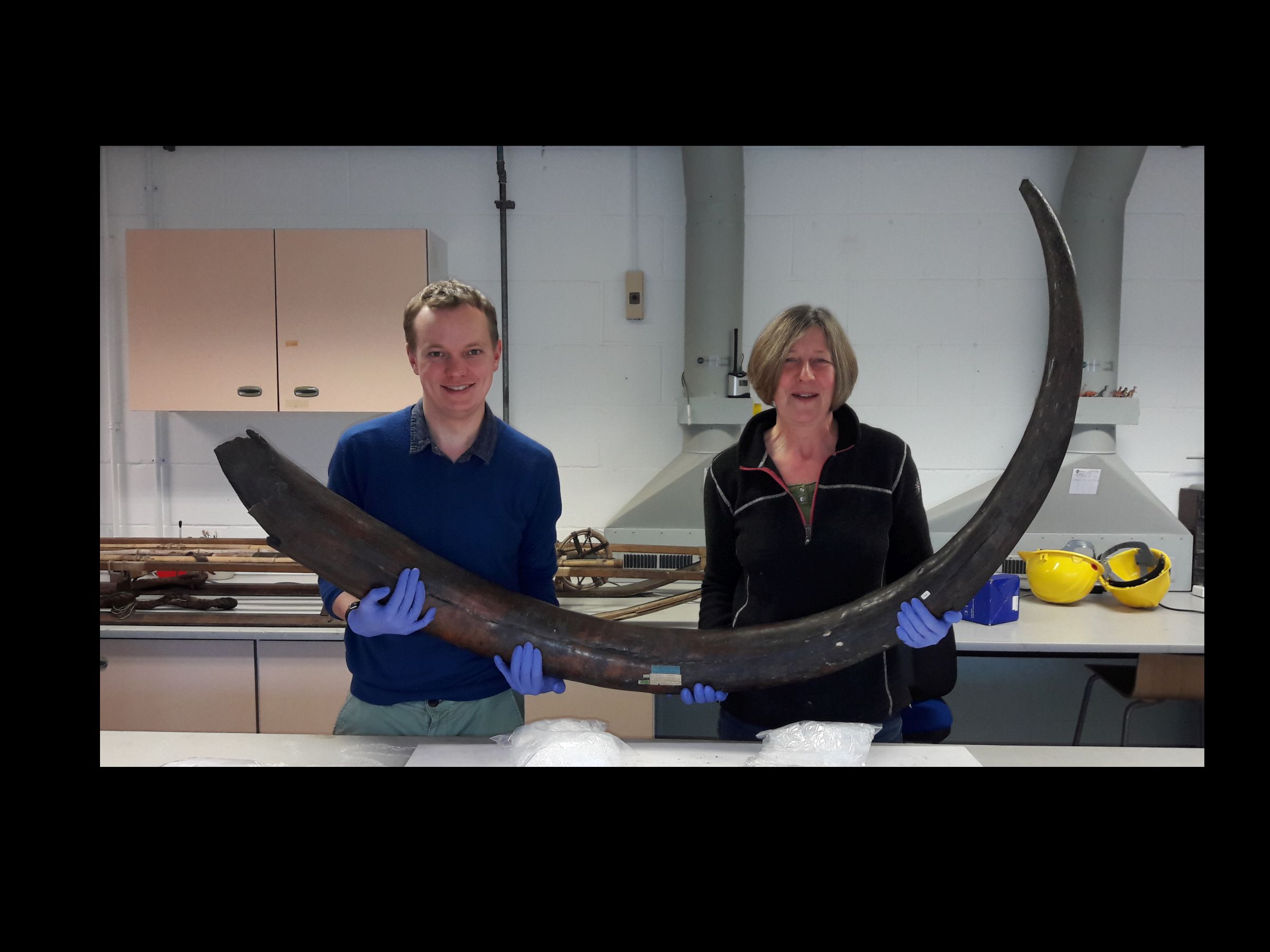
Ice Age display, Sedgwick Museum – mammoth tusks now in the Sedgwick

Glaciations
The last ice sheet to cover Cambridgeshire was thought to have occurred in the Anglian Stage glaciation which ended about 425,000 years ago. There are widespread deposits of Glacial Till and Glacial (Lake, River and other) Gravels from this glaciation in the county, particularly covering the higher land to the west and south of the Fens.
The deposits of the Lowestoft Formation date from this time and consist of gravels, cobbles and finer material. Most were carried here by glaciers that reached as far south as the Thames.
It has now also been shown that there was a glaciation that brought an ice advance as far as Cambridgeshire about 160 thousand years ago. The glaciers left a complex of deposits around the edge of the fenland, the maximum glacial limit known as the Skertchly Line. This occurred during the Late Wolstonian Substage, MIS 6.
Papers on evidence for the Late Wolstonian Glaciation including the Tottenhill ice advance into the fenland:
Late Middle Pleistocene temperate and associated events in lowland England – ScienceDirect
Late Middle Pleistocene glaciation in East Anglia, England
River Valley Sands and Gravels
Many studies have been carried out on the extensive deposits of the current and former river valleys of the region. These deposits are mostly sands and gravels carried by more powerful rivers than those that remain today. As a river system evolves it creates a series of ‘terraces’ at progressively lower levels as it cuts down into the underlying bedrock (and into older Quaternary material in some places). These broadly defined terraces have been mapped by the British Geological Survey and are shown on geology maps as Terrace 1 (the youngest), Terrace 2 (older) etc. The Great Ouse and the Cam are recorded as having 4 terraces, with Terrace 4 being the oldest and ususally found at the highest elevation.
The ages of the terraces are shown by the types of fossils found within them and by dating techniques such as pollen analysis. As reworking of older material can occur, some terraces cannot be separated definitively and some patches of sands and gravels can be very difficult to date.
In addition to the overlapping of some terraces, each terrace itself consists of a complex collection of deposits of varying composition and ages, some of which can be recognised as occuring in a range of locations along a valley. Dr Steve Boreham has carried out many studies on the deposits within the broader valley of the River Cam and has identified a number of ‘members’ within each terrace, each having a different age and slightly different identifying characteristics.
The Geology of the Middle Cam Valley, Cambridgeshire, UK Boreham, S.; Leszczynska, K. Quaternary 2019, 2, 24.
The Geology of the Wicken Vision Area, lower Cam valley, Cambridgeshire, UK. Boreham, S. Geosci. 2013, 92, 47–59
Holocene, Weichselian Late-glacial earlier Pleistocene deposits of the upper Cam valley at the Hinxton Genome Campus, Cambridgeshire, UK Boreham, S. Rolfe, C.J. Geosci. 2009, 88, 117–125
The Quaternary history of the Wash fluvial network, UK. Boreham, S. White, T.S. Bridgland, D.R. Howard, A.J. White, M.J. Proc. Geol. Assoc. 2010, 121, 393–409

Geoconservation values of Quaternary features
‘Geoconservation is the conservation of those elements of geodiversity that have significant intrinsic, scientific, educational, cultural, aesthetic, ecological or ecosystem service values. Together these elements form our geoheritage. Recognition of the value of conserving Quaternary features and sites is therefore vital both for the field-based research and education that are essential to advance Quaternary science, and also for the wider benefits for the environment and society.[
Quaternary Research Association
The focus of geoconservation is usually on sites, but may also include museum collections and specimens (e.g. of fossils). Quaternary geosites can be small but scientifically significant areas, such as a disused quarry (e.g. sand or gravel pits including Travellers’ Rest SSSI) a roadside exposure (e.g. Chalky Lane Brabaham candidate LGS), a historic research site (e.g. Wicken Sedge Fen) or extensive areas with landforms. They may be located on privately owned land, or on land in public ownership. Many are vulnerable to a range of threats, including urbanization, infrastructure development, agriculture, aggregate extraction, neglect, erosion or lack of understanding of their value. Moreover, the values of Quaternary sites are often underestimated or overlooked in national and local planning and policy.