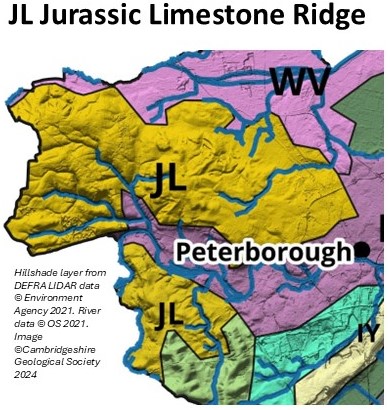
Jurassic Limestone Ridge
The Jurassic Limestone Ridge is a west-east aligned feature located between the Nene Valley and the Welland Valley. It is an area of complex Middle Jurassic bedrock underlain by mudstones (clays), sandstones and principally limestones, including the Lower Lincolnshire Limestone & the Cornbrash. In places there are patches of Oadby Glacial Till, Glacio-fluvial Gravels and Head.
The dissected ridge reaches above 70m OD. There are poorly drained soils developed on till and mudstones, and well-drained soils on gravels and limestone. There is also a small area of similar Jurassic bedrock geology to the south of the Nene valley forming the Sibson Ridge.
More information on the area is given in the Peterborough Geology Audit ‘Upon This Rock’ – see Local Sites page for details.
There are no geological SSSI and three LGS: Swaddywell Pit/Helpston Prick Pit, Thornhaugh II Quarry and Cross Leys Quarry.
Barnack Hills and Holes NNR preserves the site of an important Medieval limestone quarry, famous for the building stones that were used for Peterborough and Ely Cathedrals as well as many other buildings such as Ramsey Abbey. Castor Hanglands and Bedford Purlieus are also both NNRs.
Thornhaugh II Quarry
From the Peterborough Geology Audit ‘Upon This Rock’, 2000 (see above).
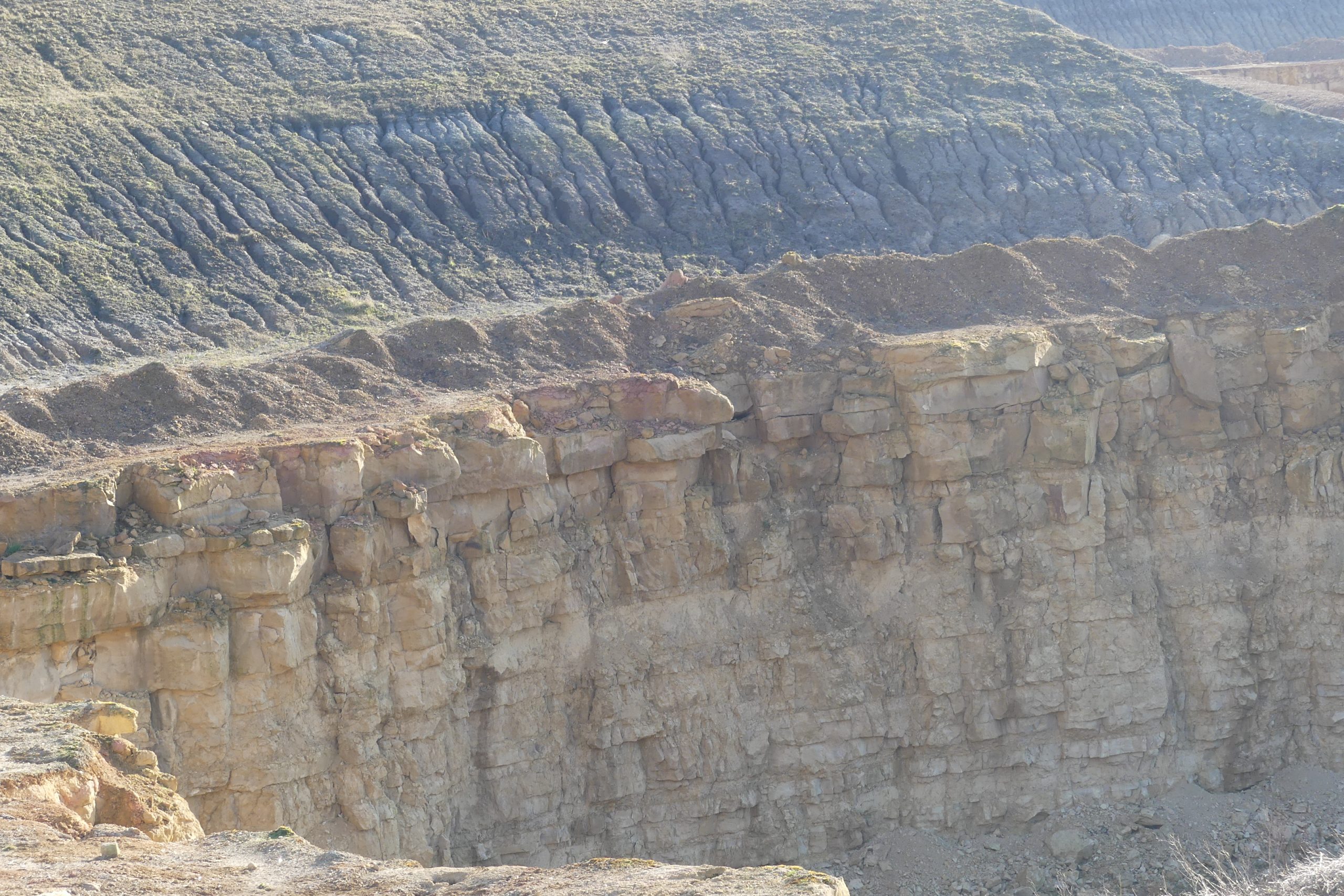
‘This site exposes the Lincolnshire Limestone Formation and Grantham Formation; the latter providing the pure running sands for the production of refractory products (fire cement). Past environments are evident in fossilised root beds, ripple marks, cross-bedding on dune and river sands. Possible tectonic activity is shown in a down-warping of the Lincolnshire Limestone over the Grantham Formation. The site displays excellent frost-shattering structures and is ideal for educational purposes at many levels. Quarrying is scheduled to continue for several years enabling access to fresh deposits.’
Cross Leys Quarry
From the Peterborough Geology Audit ‘Upon This Rock’, 2000
‘This site is scientifically important for the Lincolnshire Limestone and the Collyweston slate horizon. The decalcified limestone, dewatering structures, doggers and current bedding found here are the best examples in the region. geomorphologically, the site is interesting for excellent examples of frost shattering and cryoturbation structures. The site is ideal for many educational users.’
Nearby geological SSSI in Rutland
Ketton Quarrries SSSI
Located just outside of Cambridgeshire, Ketton Quarries geological SSSI has exposures of many of the local Jurassic Formations found in the Jurassic Limestone Ridge Landscape near Peterborough. It is an important site, described by D. Withers et al in Proceedings of the Geologists’ Association 135 (2024) 660–675) as having ‘one of the most complete sequences through the East Midlands Jurassic spanning the upper Toarcian to lower Callovian and perhaps base of the middle Callovian (Hudson and Clements, 2007).’ Their paper ‘A large pterosaur from the Middle Jurassic (lower Bajocian) of Rutland, United Kingdom’ can be downloaded here.
A full account of the site is in the 2007 paper by J. D. Hudson and R. G. Clements ‘The Middle Jurassic Succession at Ketton, Rutland’.
Swaddywell Pit/Helpston Brick Pit LGS
From the Peterborough Geology Audit ‘Upon This Rock’, 2000
‘The brickpit is extremely important to Peterborough, although it is now flooded and overgrown. It contains the Lower Estuarine series of clays and is important for archaeological finds recording an independent brickmaking operation. The clays contain microfossils. The site is off a bridleway providing easy and safe access. The nearby Marholm/Tinwell Fault which runs beneath Peterborough could be exposed should further development take place. The adjacent Swaddywell Pit, once worked for limestone but now disused, lies on the up-throw side of the fault. It displays spectacular fault drag and displacement of the Lincolnshire Limestone and sands of the Lower Estuarine series. The site has strong links with one of the first formal nature reserves in Britian (and retains considerable wildlife interest) as well as with the poet John Clare who lived locally.’